
Reader story
For ten years, I was always the one taking the picture
Then I saw one of myself. And understood what I had really been avoiding - and how long I had spent training the completely wrong muscle.

It was my mother-in-law who sent them. Three hundred photos from the summer, in one folder, and I sat on the edge of the bed on a Tuesday evening and scrolled through them all. The children on the dock. The dinner table. Someone laughing at something outside the frame.
I wasn't in a single one of them.
Not because anyone had left me out. Because I was always the one holding the phone. I had offered. I always offer. And somewhere between the year I had my youngest and that Tuesday, it had stopped being a favor and become a habit I had never put a name to.
I remember thinking: when did this start? And that I couldn't point to a single day.
Part 1 of 3
“Are you pregnant again?”
If I'm being honest, I knew perfectly well why I had moved behind the camera. I had simply never said it out loud.
Six months earlier, I had been standing in line at the store when an acquaintance put her hand on my arm, smiled warmly, and asked if I was pregnant again. I wasn't pregnant. My youngest was three and a half. I laughed it off, paid, and sat in the car before the tears came.
What hurt wasn't the question. It was that I knew exactly what she was seeing - because I saw the same thing every morning. When I was lying down, my stomach was flat. As soon as I stood up, my lower abdomen bulged forward. Sitting with slightly rounded shoulders, I looked five months pregnant.

And I had tried. Pilates for a year and a half. Abdominal exercises in the morning. Two diets I would rather not talk about. One summer of jogging three times a week. My stomach looked more or less the same as it had six weeks after giving birth.
So I came to the conclusion that I think most people eventually reach: that my body was simply like that now.
Part 2 of 3
The physiotherapist said something I had never heard before
The turning point came with a physiotherapist I sought out for something completely different - a painful shoulder. She asked me to stand up, looked at me for a moment, and said: “What you're pointing to now isn't necessarily about how much you exercise. It may be about what you train.”
She explained that the abdominal muscles we all know - the rectus abdominis and the obliques - are the outer layer. They are what shape a six-pack, and they are what sit-ups and crunches work. But underneath them lies a deeper layer: transversus abdominis, a muscle that runs transversely around the waist like an inner belt, together with the pelvic floor.
The deep layer is what gives your midsection support when you stand. And in many women - after pregnancy, after years of sitting, after hormonal changes - that layer is weaker than the outer one.
All the abdominal exercises I had done for three years had trained the outer layer. Thoroughly. I had simply never trained what lies underneath.
“The deep layer responds to something different than hard repetitions,” she said. “It responds to slow, controlled tension against light resistance. Calmly, steadily, from the inside.”
I hadn't been lacking in effort. I had been lacking the right layer.
Part 3 of 3
Ten minutes on the living room floor
The exercise she showed me required neither a studio, a trainer, nor expensive equipment. Just a pedal resistance band and a space on the floor.
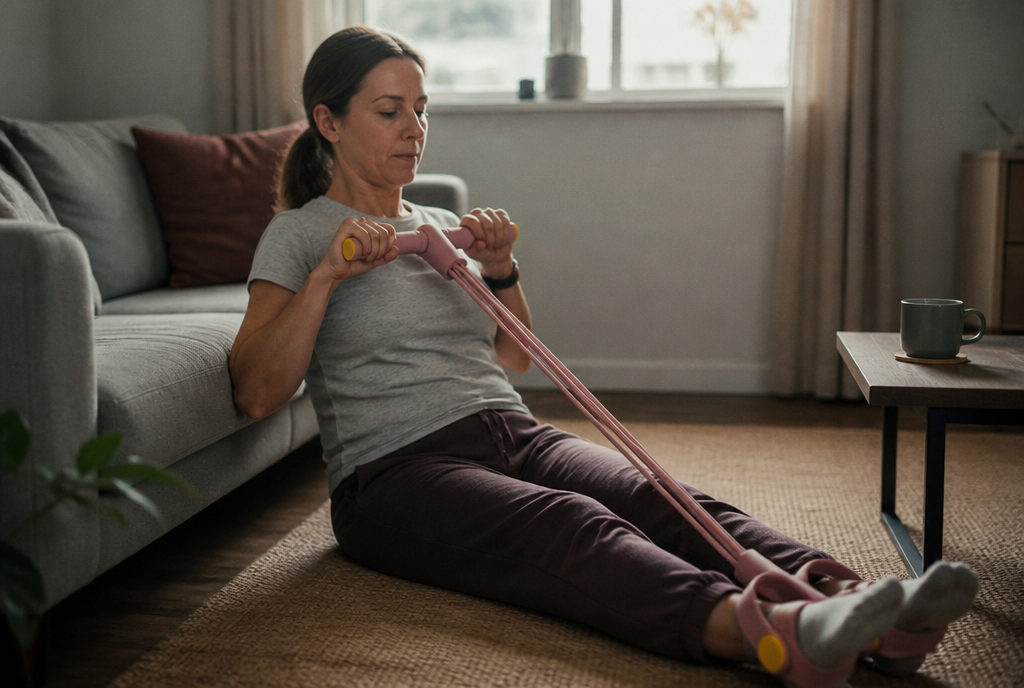
You sit on the floor with your legs straight, place the straps around your feet, and take a handle in each hand. Slowly lean back to around 45 degrees. Pull the handles toward your chest in a controlled motion as you exhale - and at the same time actively draw your stomach inward, as if you were fastening a slightly too-tight trouser button. Hold for two seconds. Return slowly.
The first time I did it correctly, I felt it immediately. Not the burning you get after fifty sit-ups, but a deep warmth low in my abdomen. Ten minutes later, I was done.
Nothing visibly happened during the first week. But something else did: the barrier was finally low enough. Ten minutes on the floor in front of the TV required no planning, no travel, and no motivational speech to myself. I exercised more times during that first week than I had the entire month before.
In week three, I wrote in the notes on my phone: “The first time my stomach doesn't bulge out when I get up from the sofa.” In week six, a pair of trousers that had been at the back of the closet for two years fit me. Around week ten, I was standing at the playground, and no one asked anything at all.
What changed wasn't just my stomach. It was that I stopped offering to take the picture.
I want to be clear that this didn't happen quickly, and that it doesn't happen equally quickly for everyone. Most people notice something after four to six weeks if they do it consistently — three times a week is enough. If you have diastasis, have recently given birth, or have experienced pelvic floor problems, talk to a midwife or physiotherapist first. That's what I did.
The equipment I use
Flexitrener
It is a pedal resistance band designed specifically for this type of seated, controlled floor exercise. Six resistance tubes instead of two or three, so the resistance remains even throughout the movement, and foot pedals that don't slip when you sit for a while.
What really made the difference for me wasn't the band. It was that it came with a plan that told me what to do every day for fourteen days, so I didn't have to figure it out myself.
- Included 14 workout videos, workout plan, and introduction video
- Time required 10 minutes, three times a week
- Gentle Sitting on the floor. No jumping, no impact.
- Delivery Free shipping in Norway, 30-day satisfaction guarantee
This article is advertising content from Flexitrener and is marked as an advertisement. The story is based on real customer experiences, and the individuals have been anonymized. The images are illustrations. Flexitrener is exercise equipment, not medical treatment, and the content does not replace advice from healthcare professionals. Individual results vary. If you have diastasis, have recently given birth, or experience pain or discomfort in the pelvic floor, we recommend consulting a midwife, doctor, or physiotherapist before you begin. © 2026 Flexitrener.